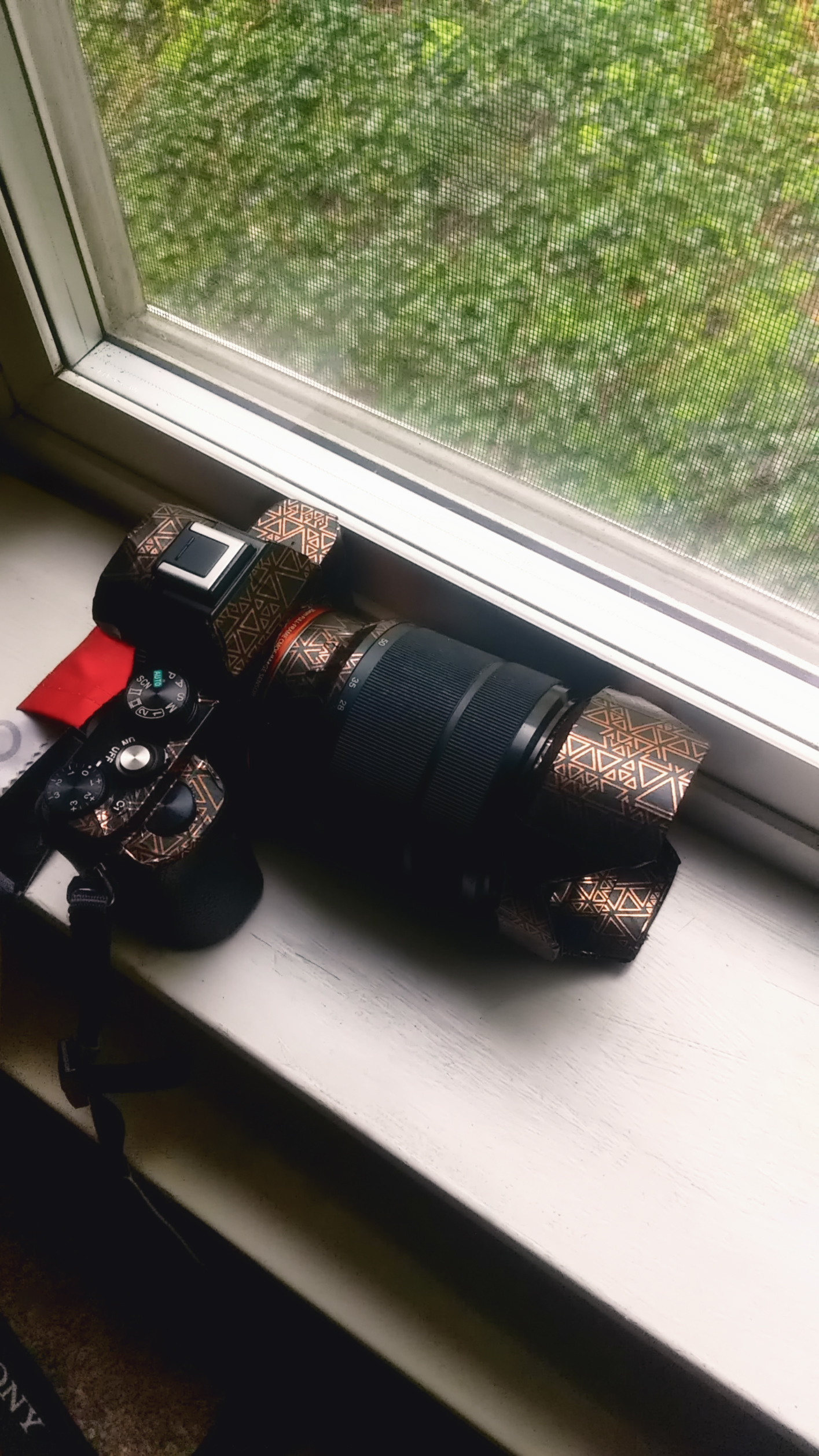
The Sternal Rolleiflex: Taming 42.4 Megapixels with Neurological Tremor
How cradling the camera at the chest, tilting the LCD 90 degrees, and configuring custom firmware scaffolds physical stability when your own nervous system is the unstable platform.
Adaptive Fieldcraft · Part 1
The Sternal Rolleiflex & Sensor Stillness
Stillness is not the absence of physical movement; it is the deliberate calibration of attention in the presence of instability. Here is how cradling the camera body against the upper abdomen rewrote my relationship with high-resolution photography.
The 42.4-Megapixel Truth
A 42.4-megapixel full-frame sensor is a ruthless truth-teller.
On the Sony Alpha 7R III-A, there is nowhere for movement to hide. Across a massive 7952 × 5304 canvas, every micro-flutter of the hands, every pulse of a heartbeat, and every hasty shutter press is recorded in crystalline, unforgiving detail.
Standard photography wisdom always offers the same textbook solution: Buy a heavy carbon fiber tripod. Lock down the ball head. Use a two-second self-timer. Step away from the camera.
In our earlier piece, The 30-Pound Ruck: Photography as Endurance Exercise, we explored the physical workload of carrying heavy glass across mountain ridgelines. But what happens when the unstable platform isn’t the loose basalt scree of the Columbia Gorge or a rain-swept coastal bluff?
What happens when the unstable platform is your own nervous system?
The Shifting Deck Inside
I live and shoot with cerebellar and sensory ataxia. In plain terms, the biological balance computer in the back of my brain—the cerebellum, and specifically its ultra-dense Purkinje cells—struggles to calculate real-time motor error corrections. My joint position sensors don’t always report accurately where my limbs are in space. Steps can feel like navigating an uneven dock in a cross-swell. And the moment my hands reach toward a target, an intention tremor can emerge.
In clinical neurobiology, when your internal proprioceptive platform loses fidelity, you survive through sensory scaffolding: you recruit your eyes, physical counter-resistance, and environmental anchors to substitute for what your inner ear and spinal nerves cannot report.
For years, conventional photography ergonomics fought my body. Bringing a heavy camera up to my eye, flaring my elbows in the wind, and trying to hold a 5-pound telephoto rig motionless against my brow ridge was an exercise in rapid fatigue. Deltoids burn, neck muscles guard, and the tremor amplifies.
Then, I stopped pretending my body was a concrete pillar. I looked down, pulled out the tilting LCD, and re-engineered my camera into an external nervous system.
The Rolleiflex Revelation: Dropping the Center of Mass
The breakthrough didn’t come from a new lens. It came from tilting the rear LCD screen 90 degrees straight up and cradling the camera against my upper abdomen, shooting like an old medium-format twin-lens reflex.
┌─────────────────────────────────────────────────────────────────────────────┐
│                 THE 4-POINT ROLLEIFLEX CHEST-BRACE HARNESS                  │
├─────────────────────────────────────────────────────────────────────────────┤
│ 1. Taut Neck Strap      │ Pushes outward/downward to create tension         │
│ 2. Sternal Docking      │ Camera body cradled directly against the torso    │
│ 3. Pinned Elbows        │ Both elbows clamped into lower ribs/iliac crests │
│ 4. 90° Upward LCD       │ Eyes gaze straight down; zero cervical neck strain│
└─────────────────────────────────────────────────────────────────────────────┘
When you bring a camera to your eye, your center of mass is high, your neck is compressed, and your arms act like long, vibrating levers.
When you drop the camera to your sternum:
- Your skeleton takes the load: Your elbows pin naturally into your lower ribs or iliac crests.
- The strap becomes an anchor: Shortening your neck sling so the camera sits taut against your upper belly creates a mechanical counter-pull that damps high-frequency micro-tremor through pure physics.
- Your visual field opens: Instead of squinting through a black tunnel, you look down into the bright display with both eyes relaxed, maintaining complete peripheral awareness of the trail.
Interactive Field Settings: Dialing in Your Rig
Whether you shoot Sony, Canon, Nikon, OM System, or Fujifilm, each system possesses specific gyroscopic tools to scaffold physical stability. Click your brand below to view the field settings calibrated for this posture:
Firmware Scaffolding for the Sony Alpha 7R III-A
Operating from the chest requires turning off automatic assumptions in camera firmware. Here are the five exact adjustments I configure to protect against accidental slips:
1. Defeating the “Chest Blackout” Trap
The built-in proximity sensor above the viewfinder is designed to detect your face. When you hug the camera to your jacket at chest height, the sensor assumes your eye is there and instantly blacks out the rear screen.
- The Fix: Go to
Camera 2 → Tab 6/9 → FINDER/MONITORand set it toMonitor(Manual). Now, the screen stays on 100% of the time, no matter how close you pull it into your chest.
2. Cutting Canopy Glare with “Sunny Weather” Mode
Looking down into an LCD under open skies can wash out contrast.
- The Fix: Go to
Setup (Yellow) → Tab 1/7 → Monitor Brightnessand lock it toSunny Weather. The screen punches up by +2 stops, rendering bark fissures, focus peaking, and dynamic range vividly visible.
3. Touch-Panel Steering (Bypassing the Joystick)
Pushing a tiny 4-way joystick with a trembling thumb often causes overshooting (dysmetria).
- The Fix: Enable
Touch Operation: OnandTouch Panel Only. With both hands cradling the camera body, my thumb simply rests near the glass. A light tap on the screen instantly drops a focus box precisely where I want it—zero button clicking required.
4. Decoupling Focus from the Shutter
The classic half-press/full-press shutter release introduces downward torque that ruins high-megapixel captures.
- The Fix: Set
AF w/ ShuttertoOff. Focus is acquired with a dedicated back-button (AF-ON) or a screen tap. The shutter button’s only job is to trigger the exposure with a feather touch.
5. The “Three-Shot Squeeze”
I leave my drive mode set to Continuous Shooting: Lo (~3 fps). When framing a scene, I never take a single frame. I breathe out, squeeze, and hold for three soft clicks:
- Frame 1: Absorbs the initial downward press of the finger.
- Frame 3: Catches the muscle release.
- Frame 2: Almost always tack-sharp. Captured in the micro-second pause when the finger was completely motionless.
The Bioenergetic Rhythm: Shooting on the Empty Lung
In our systems biology research at PocketGull, we study 0.10 Hz Mayer wave cardiorespiratory resonance—breathing at roughly 6 breaths per minute (4 seconds in, 6 seconds out).
Shooting on a full lung traps air in the chest, elevating blood pressure and triggering isometric muscle tremors.
On the trail, I wait for the bottom of the breath:
- Frame the shot on the tilted screen.
- Verify the Dual-Axis Level Gauge (two green horizontal lines indicate the horizon is plumb).
- Inhale smoothly, then let the air fall out naturally.
- At the empty pause at the bottom of the exhale, parasympathetic vagal tone surges, heart rate decelerates, and skeletal tension drops.
- Click-click-click.
When Shake Becomes Art: The Wabi-Sabi Shutter
There are days when my nervous system simply will not be quieted. The wind is cold, fatigue sets in, or the trail has taken its metabolic toll.
Years ago, that used to mean packing up the bag in frustration. Today, it means turning the Mode Dial to Slot 3: Sumi-e Flow.
I drop the shutter to 1/15s, keep the aperture at f/8, switch my 70–200mm GM II lens to OSS Mode 2 (Panning), and stop fighting the tremor. Instead of clamping down, I initiate a deliberate, sweeping torso rotation from the hips, drawing the camera along the vertical trunks of Douglas firs.
The vertical axis remains stabilized by Sony’s gyroscopes, while the horizontal motion melts into an impressionistic, watercolor wash reminiscent of traditional Japanese brush calligraphy. What was once viewed as a neurological “deficit” becomes a signature aesthetic—an unrepeatable record of human kinetic energy dancing with light.
Stillness as a Practice
Photography is often sold as a pursuit of machine-like perfection: robotic tripods, computerized autofocus, clinical sharpness.
As we reflected in The Voice of Reason: 22-Year Lens Audit, photography is fundamentally an optical window of presence. Out on the trail, holding a 42.4-megapixel instrument against an unsteady chest, you realize something deeper: Stillness is not the absence of movement. Stillness is the deliberate calibration of attention in the presence of instability.
The camera does not care that your biological platform wobbles. With its sensor floating on magnetic coils, its screen tilted toward the sky, and its firmware tuned to support your hands, it meets you halfway. It allows an unsteady human being to step into old-growth forests and freeze a single, breathtaking second of eternity.
If your hands shake, if your joints ache, or if your balance isn’t what it used to be: do not leave your camera on the shelf. Pull it tight to your chest, look down into the glass, breathe out, and make your art.
Works Cited & Further Reading
- PocketGull Research Group. Ataxia, Purkinje Bioenergetics, and Sensory Scaffolding: Mitochondrial ATP Preservation in Motor Coordination. PocketGull Systems Biology Monographs, 2026.
- Phil Gear. The Architect Over the Typist: Agentic AI and the Future of Vocational Rehabilitation. philgear.dev, 2026.
- Phil Gear. PocketGull Font Superfamily: Louise Sloan 5:1 Optotypes, ISMP Clinical Disambiguation & Telemetry Monospace. PocketGull Typefoundry & Zenodo, 2026.
- PG PhotoTrek & PocketGull. PocketGull Field Health & Optical Gym: 0.10 Hz Vagal Respiration and Sloan Optotype Calibration. Field Odyssey, 2026.